
Gear teeth cutting is one of the most important processes in precision gear manufacturing. Gears are essential components used to transfer motion, speed, and torque between rotating shafts. They are widely used in automotive equipment, agricultural machinery, industrial machines, construction equipment, marine systems, and power transmission applications.
The quality and accuracy of gear teeth have a direct impact on the performance, efficiency, noise, vibration, and service life of the complete gear system. This is why selecting the right gear teeth cutting process and an experienced gear manufacturer is important for industrial applications.
What Is Gear Teeth Cutting?
Gear teeth cutting is a machining process used to create the required teeth profile on a gear blank. During this process, material is precisely removed from the gear blank using specialized cutting tools and machines.
The number of teeth, tooth profile, module, pressure angle, gear diameter, face width, and other specifications are determined according to the application. The cutting method is then selected based on the type and size of the gear.
A properly manufactured gear should have accurate tooth spacing and geometry so that it can mesh correctly with its mating gear.
Why Is Gear Teeth Cutting Important?
Accurate gear teeth are essential for smooth and reliable power transmission. If the teeth are manufactured incorrectly, the gear may experience excessive vibration, noise, wear, or uneven loading.
Precision gear teeth cutting helps provide:
- Smooth gear operation
- Accurate power transmission
- Reduced noise and vibration
- Better load distribution
- Improved wear resistance
- Longer gear service life
- Reliable machine performance
For heavy-duty industrial machinery, even small variations in gear tooth dimensions can affect the overall performance of the equipment.
Gear Teeth Cutting Process
The gear manufacturing process generally involves several important stages.
1. Gear Design
The process starts with determining the technical specifications of the gear. These may include the number of teeth, module, pressure angle, diameter, material, face width, and required tolerances.
2. Gear Blank Preparation
The selected raw material is machined into a gear blank. The blank is prepared according to the required dimensions before the teeth are cut.
3. Gear Teeth Cutting
The prepared gear blank is mounted on suitable gear-cutting machinery. The selected cutting tool removes material to create the required tooth profile.
4. Heat Treatment
Depending on the material and application, heat treatment may be carried out to improve hardness, strength, toughness, and resistance to wear.
5. Finishing
Additional machining or finishing operations may be performed to achieve the required accuracy and surface finish.
6. Quality Inspection
The finished gear is inspected to verify important dimensions, tooth accuracy, runout, hardness, and other specifications.
Common Gear Teeth Cutting Methods
Different gear cutting methods are used depending on the type and requirements of the gear.
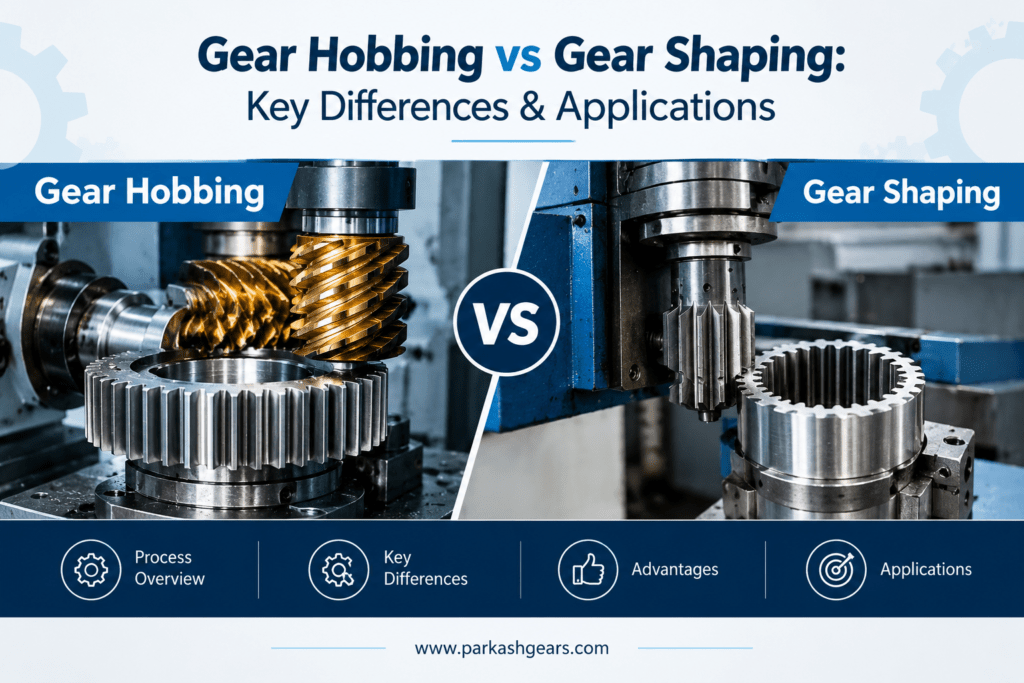
Gear Hobbing
Gear hobbing is a widely used gear manufacturing method. It uses a rotating cutting tool called a hob to generate gear teeth. It is commonly used for producing spur gears, helical gears, and other cylindrical gears.
Gear Shaping
Gear shaping uses a specialized cutter that moves relative to the gear blank to produce the required tooth profile. It is useful for certain gear designs where hobbing may not be suitable.
Gear Milling
Gear milling uses a milling cutter to machine individual gear teeth. It can be suitable for specific production requirements, prototypes, and certain large or specialized gears.
The correct gear cutting method depends on factors such as gear design, material, production volume, required accuracy, and application.
Applications of Gear Teeth Cutting
Precision-cut gears are used across many industries. Some common applications include:
- Automotive and transmission systems
- Agricultural machinery
- Construction equipment
- Textile machinery
- Marine equipment
- Industrial machinery
- Power transmission systems
- Packaging and processing machinery
Because each application has different operating conditions, gears must be manufactured according to the required load, speed, environment, and performance requirements.
Importance of Choosing the Right Gear Manufacturer
Choosing an experienced gear manufacturer in India is essential when you require reliable industrial gears. A professional manufacturer should have suitable machinery, technical expertise, quality-control systems, and experience in producing gears for different industrial applications.
Factors such as material selection, machining accuracy, gear tooth profile, heat treatment, finishing, and inspection can all influence the final quality of the gear.
For custom gears, customers should provide complete technical details such as drawings, dimensions, material specifications, operating conditions, and required tolerances.
Parkash Gears – Industrial Gear Manufacturing
Parkash Gears is an experienced gear manufacturing company serving a wide range of industrial requirements. The company manufactures precision gears and gear components for various applications where accurate power transmission and dependable performance are required.
From gear teeth cutting and machining to heat treatment, finishing, and inspection, every stage of the manufacturing process contributes to the quality and performance of the finished gear.
For businesses looking for precision gear manufacturing, industrial gears, custom gears, or gear teeth cutting, working with an experienced manufacturer can help ensure reliable and long-lasting solutions.
Conclusion
Gear teeth cutting is a fundamental part of the gear manufacturing process. Accurate cutting ensures that gear teeth have the correct shape, spacing, and dimensions for smooth engagement with mating gears.
Modern gear-cutting methods such as hobbing, shaping, and milling allow manufacturers to produce different types of gears according to specific industrial requirements. Combined with appropriate material selection, heat treatment, finishing, and quality inspection, precision gear teeth cutting helps deliver reliable gear performance.
For high-quality industrial gear requirements, Parkash Gears provides manufacturing solutions designed around the specific needs of different industries and applications.