
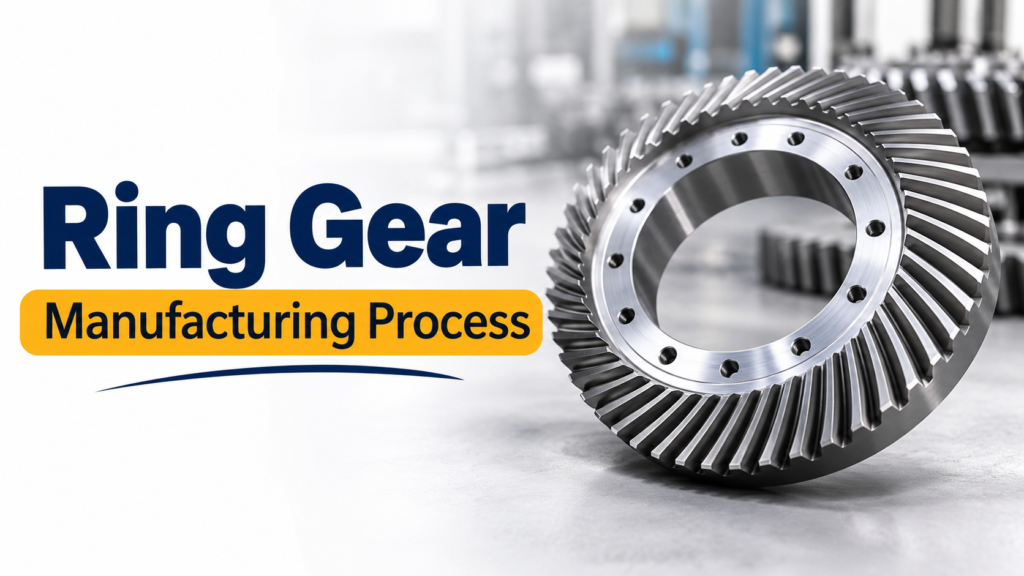
Ring gears are essential components used in various industrial machines, automotive systems, heavy equipment, and power transmission applications. They are designed to transfer rotational motion and distribute mechanical power efficiently. Due to their important role in machinery performance, ring gears must be manufactured with high precision, strength, and durability.
The ring gear manufacturing process involves several stages, starting from raw material selection and gear design to machining, heat treatment, and final quality inspection. Each stage plays an important role in ensuring that the finished gear meets the required technical specifications.
In this blog, we will explore the complete ring gear manufacturing process and understand how a professional ring gear manufacturer maintains product quality.
1. Raw Material Selection
The first step in ring gear manufacturing is selecting the right raw material. Material selection depends on the application, operating conditions, load capacity, and required durability.
Common materials used for manufacturing ring gears include:
Alloy Steel: Provides high strength and wear resistance for demanding industrial applications.
Carbon Steel: Suitable for general-purpose mechanical and power transmission applications.
Stainless Steel: Used where corrosion resistance is an important requirement.
Cast Iron: Suitable for specific industrial machinery and heavy-duty applications.
Choosing the correct material helps improve the strength, durability, and service life of the finished ring gear.
2. Ring Gear Design and Engineering
After selecting the raw material, the next step is designing the ring gear according to customer requirements.
A ring gear manufacturer considers several technical specifications during the design stage, including:
Number of teeth.
Module and pressure angle.
Pitch diameter and outside diameter.
Face width and tooth profile.
Internal or external gear configuration.
Material grade and hardness requirements.
Accurate engineering and design help ensure proper gear engagement, smooth operation, and compatibility with the machinery.
Custom ring gears can also be manufactured according to customer drawings and specific application requirements.
3. Raw Material Cutting and Preparation
Once the design is finalized, the selected raw material is prepared for machining.
The material is cut into the required dimensions using suitable cutting equipment. Depending on the gear design, additional preparation operations may include forging, casting, or machining the initial gear blank.
The purpose of this stage is to create a suitable workpiece for the subsequent manufacturing operations while maintaining the required dimensional allowances.
4. Ring Gear Machining and Tooth Cutting
Machining is one of the most important stages in the ring gear manufacturing process.
During this stage, the gear blank is machined to achieve the required dimensions and tooth geometry. Depending on the design, manufacturers may use CNC machining, gear shaping, gear hobbing, or other specialized gear-cutting methods.
These processes help achieve accurate tooth profiles and proper gear engagement.
Precision machining is particularly important for industrial ring gears because even small dimensional variations can affect noise levels, vibration, and overall machinery performance.
5. Heat Treatment for Strength and Durability
Heat treatment is performed when specific mechanical properties are required.
Depending on the material and application, manufacturers may use processes such as:
Hardening: Improves surface hardness and wear resistance.
Tempering: Helps achieve the required balance of hardness and toughness.
Induction Hardening: Provides localized surface hardening in suitable gear designs.
Proper heat treatment helps improve the durability and load-bearing performance of ring gears. The selected treatment depends on the material grade, gear dimensions, and customer specifications.
6. Surface Finishing and Precision Correction
After machining and heat treatment, additional finishing operations may be required to achieve the desired dimensional accuracy and surface quality.
These operations may include grinding, deburring, and other finishing methods depending on the gear specifications.
Proper surface finishing helps reduce irregularities, improve tooth contact, and support smooth mechanical operation.
7. Final Inspection and Quality Control
Quality inspection is the final and one of the most important stages before delivering the finished product.
A professional ring gear manufacturing company checks the finished gears against approved technical drawings and quality requirements.
Important inspection parameters include:
Gear tooth dimensions and profile.
Pitch diameter and outside diameter.
Bore dimensions and concentricity.
Runout and dimensional accuracy.
Surface finish.
Material hardness.
Overall manufacturing tolerances.
Specialized measuring instruments and gear inspection equipment may be used to verify dimensional accuracy.
A proper quality control process ensures that the finished ring gears meet customer expectations and application requirements.
8. Why Choose an Experienced Ring Gear Manufacturer?
Choosing the right ring gear manufacturer is essential for obtaining reliable products for industrial applications.
An experienced manufacturer can offer:
Custom ring gears according to technical drawings.
Suitable material selection.
Precision machining capabilities.
Consistent manufacturing quality.
Proper dimensional inspection.
Solutions for different industrial applications.
Working with a reliable manufacturing partner can help improve machinery performance, reduce maintenance requirements, and support long-term operational efficiency.
Conclusion
The ring gear manufacturing process involves multiple stages, including raw material selection, engineering design, material preparation, precision machining, heat treatment, surface finishing, and final inspection.
Every stage contributes to the strength, accuracy, and reliability of the finished gear. Choosing an experienced ring gear manufacturer ensures that products are manufactured according to specific industrial requirements and quality standards.
Whether you require custom ring gears for automotive systems, heavy machinery, or industrial power transmission, selecting a manufacturer with suitable technical expertise and quality control capabilities is important for achieving dependable performance.