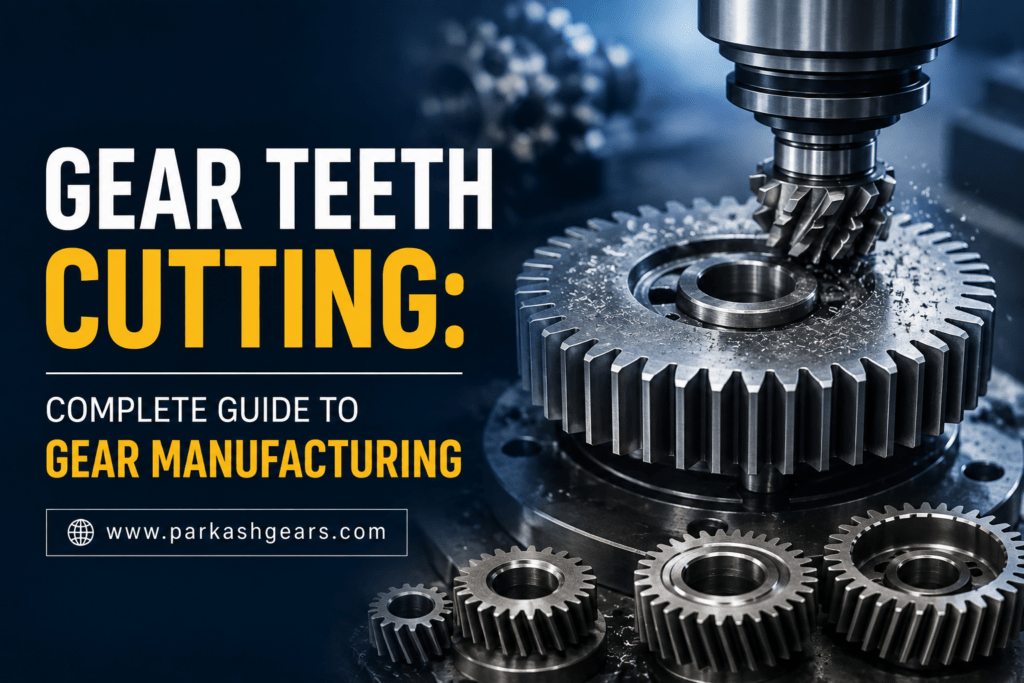

Gear teeth cutting is a fundamental process in gear manufacturing that creates the precise teeth required for smooth and efficient power transmission. Gears are used in a wide range of industries, including automotive, agriculture, construction, textile, marine, and industrial machinery.
The accuracy of gear teeth plays an important role in the performance, durability, and reliability of a gear system. Properly manufactured gear teeth help ensure smooth engagement between mating gears while reducing unwanted noise, vibration, and wear.
What Is Gear Teeth Cutting?
Gear teeth cutting is a machining process in which material is removed from a gear blank to create the required tooth shape and profile. Specialized machines and cutting tools are used according to the type, size, material, and specifications of the gear.
Before cutting begins, important parameters such as the number of teeth, module, pressure angle, pitch diameter, face width, and tooth profile are determined. Accurate machining of these parameters ensures that the finished gear performs correctly in its intended application.
Common Types of Gear Teeth Cutting
Different gear cutting methods are used depending on the gear design and manufacturing requirements.
1. Gear Hobbing
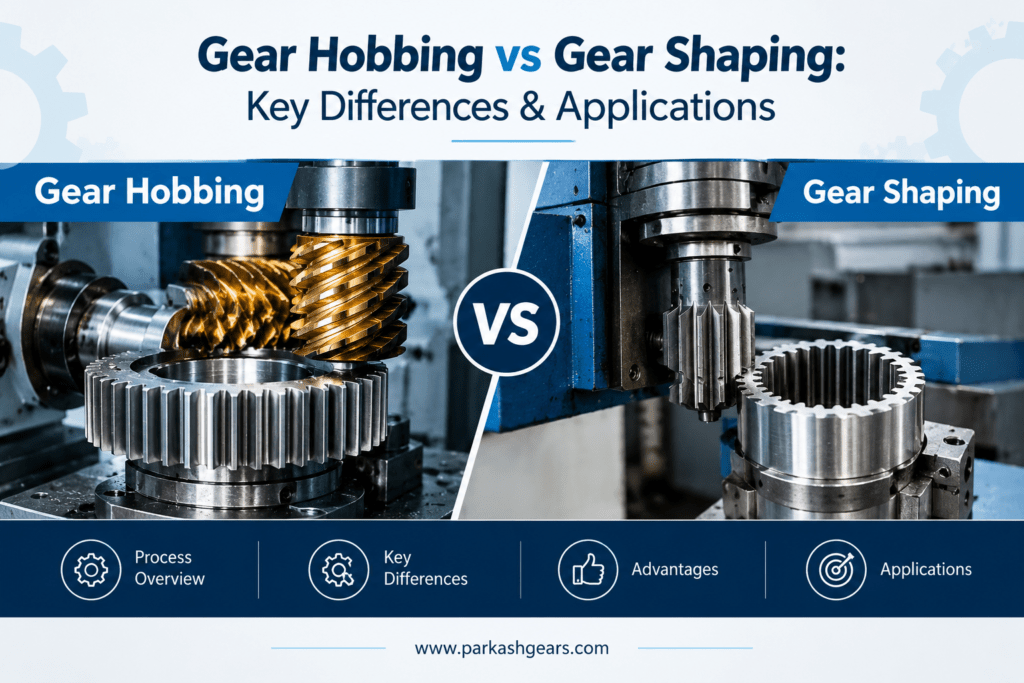
Gear hobbing is one of the most widely used methods for producing gear teeth. A rotating cutting tool called a hob works together with the rotating gear blank to generate the required teeth.
It is commonly used for manufacturing spur gears, helical gears, and other cylindrical gears. Hobbing is suitable for both consistent production and high-volume manufacturing.
2. Gear Shaping
Gear shaping uses a specialized cutter that moves in a reciprocating motion while generating the gear teeth. This process is useful for different gear designs and can be particularly suitable for internal gears and applications where hobbing is not practical.
3. Gear Milling
Gear milling uses a milling cutter to produce individual gear teeth. It can be suitable for smaller production quantities, prototypes, large gears, and specialized gear manufacturing requirements.
The appropriate cutting method depends on the required accuracy, gear geometry, production quantity, and material.
Benefits of Precision Gear Teeth Cutting
Accurate gear teeth cutting provides several important benefits for industrial applications.
Smooth Power Transmission
Precisely manufactured teeth allow mating gears to engage correctly, helping transfer motion and torque efficiently from one shaft to another.
Reduced Noise and Vibration
Incorrect tooth profiles or spacing can result in excessive noise and vibration. Precision cutting helps improve the smoothness of gear operation.
Improved Durability
Accurate tooth geometry helps distribute loads more effectively across the gear teeth. This can reduce uneven wear and contribute to longer service life.
Better Performance
High-quality gear teeth support reliable machine operation, particularly in equipment that operates continuously or under heavy loads.
Consistent Manufacturing
Modern gear-cutting machinery allows manufacturers to produce gears with consistent dimensions and tooth profiles, which is particularly important for industrial applications.
Gear Teeth Cutting Process
The basic process begins with selecting suitable raw material and preparing the gear blank. The blank is then machined to the required dimensions.
After preparation, the appropriate gear teeth cutting process is selected. Once the teeth are generated, additional operations such as deburring, heat treatment, grinding, or finishing may be performed depending on the application.
Finally, the finished gear undergoes quality inspection. Important characteristics such as tooth dimensions, profile, runout, hardness, and surface finish may be checked to ensure the gear meets the required specifications.
Applications of Gear Teeth Cutting
Precision gears manufactured through gear teeth cutting are used in many industries, including:
- Automotive and transmission systems
- Agricultural machinery
- Construction equipment
- Textile machinery
- Marine equipment
- Industrial machinery
- Power transmission systems
- Packaging machinery
- Heavy engineering equipment
Each industry may require different gear materials, dimensions, tooth profiles, and accuracy levels.
Why Choose an Experienced Gear Manufacturer?
The quality of the final gear depends on several factors, including material selection, machine accuracy, cutting tools, manufacturing processes, heat treatment, finishing, and inspection.
Working with an experienced gear manufacturer in India can help ensure that gears are manufactured according to specific technical requirements. For custom industrial gears, manufacturers can work with customer drawings, dimensions, materials, tolerances, and application requirements.
Parkash Gears – Precision Gear Manufacturing
Parkash Gears provides precision gear manufacturing solutions for a wide range of industrial applications. The manufacturing process focuses on accurate gear teeth cutting, machining, finishing, heat treatment, and quality inspection.
With the right combination of engineering expertise, manufacturing technology, and quality control, Parkash Gears helps deliver reliable gears designed for demanding industrial applications.
Whether you require industrial gears, custom gears, precision gear manufacturing, or gear teeth cutting, choosing the right manufacturing partner is essential for achieving dependable performance.
Conclusion
Gear teeth cutting is an essential part of modern gear manufacturing. Different methods, including hobbing, shaping, and milling, allow manufacturers to produce gears for a wide range of applications.
Precision gear teeth help provide smooth power transmission, reduced vibration, improved durability, and reliable machine performance. By combining accurate machining with suitable materials, heat treatment, finishing, and quality inspection, manufacturers can produce gears capable of meeting demanding industrial requirements.
For precision and custom gear manufacturing requirements, Parkash Gears offers reliable solutions designed to meet the needs of various industries.