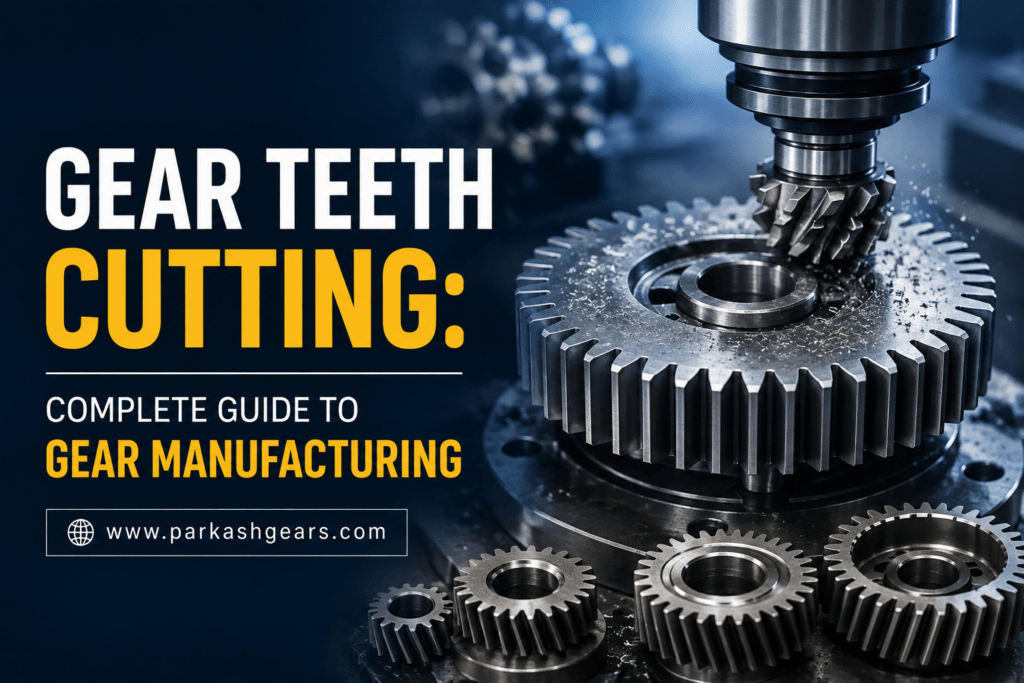

Helical gears are widely used in industrial machinery because their angled teeth provide smooth and continuous engagement between mating gears. They are commonly found in gearboxes, automotive systems, agricultural machinery, industrial drives, and other power transmission equipment.
The quality of helical gear teeth cutting plays an important role in determining the accuracy, smoothness, noise level, and operating performance of the finished gear. For industries looking for helical gear manufacturing in Ludhiana, understanding the cutting process can help in selecting the right gear manufacturer and specifications.
What Is Helical Gear Teeth Cutting?
Helical gear teeth cutting is the machining process used to produce the angled teeth of a helical gear. Unlike spur gears, whose teeth are parallel to the gear axis, helical gear teeth are positioned at a specific helix angle.
During manufacturing, the cutting tool and gear blank must work together with precisely controlled rotational movement to produce the required tooth profile and helix angle.
The final gear specifications depend on factors such as module, number of teeth, pressure angle, helix angle, face width, gear diameter, material, and required accuracy.
Helical Gear Teeth Cutting Process
The helical gear cutting process generally involves several stages.
1. Gear Design and Specifications
Manufacturing starts with the gear drawing or technical specifications. The manufacturer determines important parameters such as:
- Number of teeth
- Module
- Helix angle
- Pressure angle
- Pitch diameter
- Face width
- Bore diameter
- Material
- Required accuracy
Correct specifications are essential because even small dimensional errors can affect how the gear meshes with its mating gear.
2. Preparing the Gear Blank
The selected raw material is first machined into the required gear blank. Turning, facing, and boring operations may be carried out to achieve the required outside diameter, bore, and width.
Accurate preparation of the gear blank provides a stable foundation for the tooth-cutting operation.
3. Gear Hobbing
Gear hobbing is one of the commonly used methods for cutting helical gear teeth. A specialized hob cutter engages with the rotating gear blank while both movements are synchronized.
For helical gears, the machine setup must account for the required helix angle. Proper alignment and synchronization are important for producing a consistent tooth profile across the gear width.
4. Gear Shaping
Gear shaping is another method that can be used for certain helical gear manufacturing requirements, depending on the machine, gear geometry, and production specifications.
The appropriate cutting method is selected based on factors such as gear size, tooth geometry, production quantity, and required accuracy.
5. Heat Treatment
After tooth cutting, heat treatment may be used when the application requires increased hardness, strength, or wear resistance.
The selected treatment depends on the material and operating requirements of the gear. Heat treatment must also be controlled carefully because dimensional changes can occur during the process.
6. Finishing and Inspection
After heat treatment, additional finishing operations may be required to achieve the required dimensions and surface condition.
The finished helical gear can be inspected for parameters such as tooth profile, helix angle, runout, dimensions, bore accuracy, and surface finish.
Proper inspection helps ensure that the gear meets the required specifications before it is used in machinery.
Methods Used for Helical Gear Teeth Cutting
Different manufacturing methods may be selected depending on the gear design and production requirements.
Hobbing: Suitable for producing many types of helical gears efficiently and consistently.
Shaping: Useful for specific gear geometries and applications where the machine setup is suitable.
Grinding: Generally used as a precision finishing process when higher gear accuracy and surface quality are required.
The right method depends on the gear specifications, material, production volume, and required accuracy.
Benefits of Proper Helical Gear Teeth Cutting
Accurate helical garari teeth cutting can provide several advantages:
- Consistent tooth geometry
- Smooth gear engagement
- Reliable power transmission
- Reduced unwanted vibration
- Better dimensional consistency
- Suitable performance for industrial applications
- Improved compatibility between mating gears
Actual gear performance also depends on proper design, material, heat treatment, lubrication, alignment, and operating conditions.
Applications of Helical Gears
Helical gears are used in many industries where smooth and reliable power transmission is required. Common applications include:
- Industrial gearboxes
- Automotive systems
- Agricultural machinery
- Manufacturing equipment
- Material handling machinery
- Heavy engineering equipment
- Power transmission systems
- Industrial drives
- Customized mechanical machinery
Their ability to provide gradual tooth engagement makes them useful in applications where smooth transmission is important.
Helical Garari Manufacturing in Ludhiana
Ludhiana is an important engineering and manufacturing center in Punjab, serving industries such as agriculture, automotive, machinery, and industrial manufacturing.
For companies searching for helical garari manufacturing in Ludhiana, selecting a manufacturer with suitable machining, gear-cutting, finishing, and inspection capabilities is important. The manufacturer should be able to work according to technical drawings and application-specific requirements.
Parkash Gears provides industrial gear manufacturing solutions for different applications and gear requirements. Customers can discuss specifications such as gear dimensions, material, module, helix angle, number of teeth, and operating conditions before production.
How to Choose a Helical Gear Manufacturer
When choosing a helical gear manufacturer in Ludhiana, consider:
- Manufacturing experience
- Gear design and machining capabilities
- Material selection
- Gear cutting processes
- Heat treatment requirements
- Finishing and inspection
- Ability to manufacture custom gears
- Quality control procedures
A detailed technical discussion before manufacturing can help ensure that the finished gear is suitable for its intended application.
Conclusion
Helical gear teeth cutting is a precision manufacturing process that requires accurate gear design, proper machine setup, controlled tooth cutting, and careful inspection. Hobbing, shaping, and grinding can be used at different stages depending on the gear design and required level of precision.
For businesses looking for helical garari manufacturing in Ludhiana, working with an experienced gear manufacturer can help ensure that the gear is manufactured according to the required technical specifications and application needs.