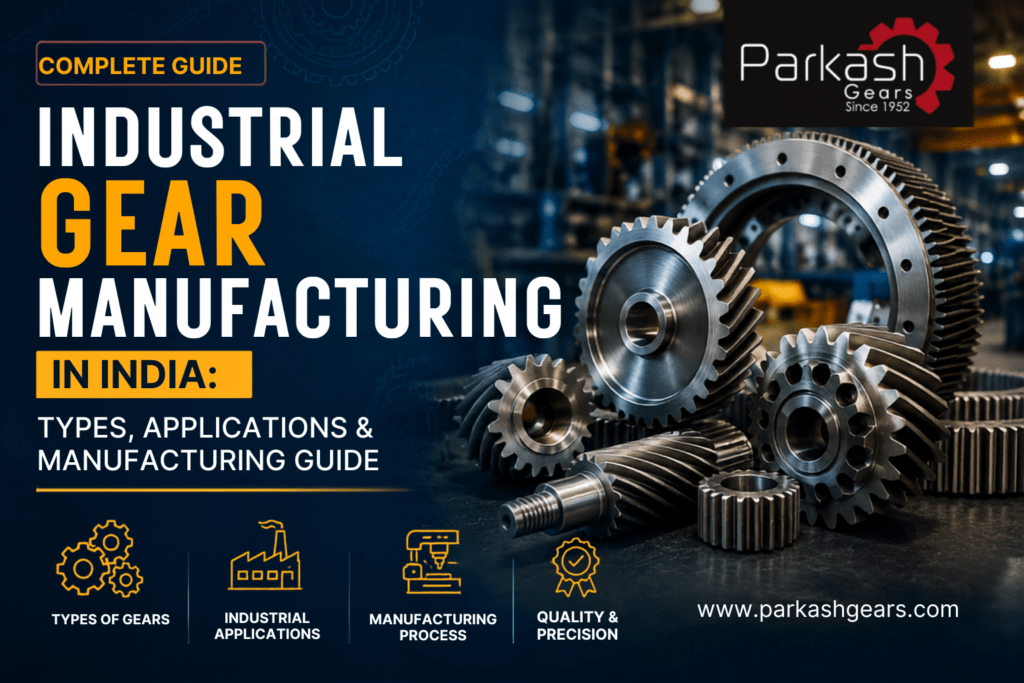

Spur gears are one of the most widely used gear types in mechanical power transmission. Their simple tooth design, reliable performance, and ease of manufacturing make them suitable for a wide range of industrial machines and equipment. From agricultural machinery to automotive components and industrial gearboxes, spur gears play an important role in transferring motion and torque efficiently.
For businesses looking for spur gear manufacturing in Ludhiana, choosing an experienced gear manufacturer is important to ensure accurate dimensions, proper tooth profiles, suitable materials, and consistent quality.
What Is a Spur Gear?
A spur gear is a cylindrical gear with straight teeth positioned parallel to the gear axis. When two spur gears mesh together, they transfer rotational motion and power between parallel shafts.
Because of their straightforward design, spur gears are relatively easy to manufacture, inspect, maintain, and replace. They are commonly used where simple and reliable power transmission is required.
Spur garari Manufacturing Process
The spur garari manufacturing process involves several important stages. Each stage contributes to the final accuracy, strength, and performance of the gear.
1. Gear Design and Specification
The process begins with understanding the machine requirements. Important specifications include gear diameter, number of teeth, module or diametral pitch, pressure angle, bore size, face width, material, and required accuracy.
A proper gear design helps ensure that the finished gear is suitable for the intended application.
2. Material Selection
Material selection is an important part of industrial gear manufacturing. Depending on the application, gears may be manufactured using suitable grades of carbon steel, alloy steel, or other engineering materials.
The selected material should be appropriate for the expected load, speed, operating environment, and service requirements.
3. Gear Blank Preparation
Before cutting the teeth, the raw material is machined into a gear blank. Operations such as turning, boring, and facing may be carried out to achieve the required basic dimensions.
Accurate gear blank preparation helps maintain proper alignment during the tooth-cutting process.
4. Gear Tooth Cutting
Gear teeth are then produced using suitable manufacturing methods and machinery. Gear hobbing is a commonly used process for manufacturing spur gears because it can produce consistent tooth profiles efficiently.
Depending on the gear design, production requirements, and specifications, other gear-cutting methods may also be used.
5. Heat Treatment
For applications involving significant loads and wear, heat treatment may be used to achieve the required hardness and mechanical properties.
The appropriate heat treatment depends on the gear material and application. Proper control is important because excessive dimensional changes can affect gear accuracy.
6. Finishing and Inspection
After machining and heat treatment, additional finishing operations may be required. The finished gear is inspected for important parameters such as tooth profile, dimensions, runout, bore accuracy, and surface condition.
Quality inspection helps ensure that the gear meets the required manufacturing specifications before it is supplied to the customer.
Benefits of Spur Gears (Garari)
Spur gears offer several advantages for industrial applications:
- Simple and reliable design
- Efficient power transmission
- Easy maintenance
- Suitable for parallel shafts
- Straightforward manufacturing
- Wide range of sizes and applications
- Cost-effective for many mechanical systems
However, spur gears can produce more noise at higher speeds compared with some other gear designs. Therefore, the gear type should always be selected according to the machine’s speed, load, noise requirements, and operating conditions.
Industrial Uses of Spur Gears
Spur gears are used across many industries because of their simple and dependable power transmission characteristics.
Common applications include:
- Industrial gearboxes
- Agricultural machinery
- Automotive equipment
- Manufacturing machinery
- Material handling equipment
- Pumps and mechanical systems
- Power transmission equipment
- Industrial machines
- Custom mechanical assemblies
The exact gear specifications should be selected according to the machine design and operating requirements.
Choosing a Spur Gear Manufacturer in Ludhiana
When searching for a spur gear manufacturer in Ludhiana, businesses should consider more than just price. Manufacturing experience, material selection, machining accuracy, inspection procedures, customization capabilities, and production consistency are important factors.
A reliable gear manufacturer in Ludhiana should be able to understand the customer’s application and manufacture gears according to the required technical specifications.
For custom requirements, customers should provide details such as gear dimensions, number of teeth, material, bore size, module, pressure angle, operating speed, and load requirements whenever available.
Spur Gear Manufacturing in Ludhiana
Ludhiana has a strong engineering and manufacturing ecosystem serving agricultural, automotive, machinery, and industrial sectors. Spur gear manufacturing in Ludhiana supports businesses that require both standard and application-specific power transmission components.
Parkash Gears manufactures industrial gears for different applications and focuses on producing gears according to customer requirements. With the right design, material, machining, finishing, and inspection process, spur gears can provide dependable performance in many mechanical systems.
Conclusion
Spur gear manufacturing combines engineering design, material selection, precision machining, tooth cutting, heat treatment, finishing, and quality inspection. Although the design of a spur gear is relatively simple, manufacturing accuracy is essential for reliable operation.
If you are looking for spur gear manufacturing in Ludhiana, working with an experienced spur gear manufacturer can help you select and manufacture gears according to your machinery requirements.