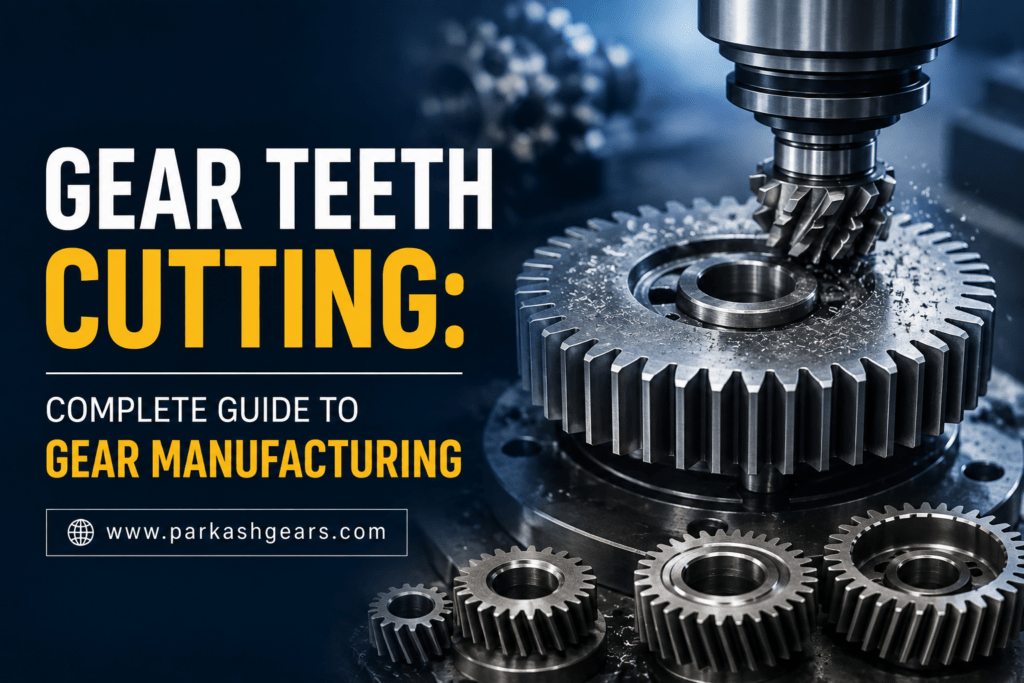

Gear manufacturing involves different processes for producing accurate and reliable gear teeth. Two common methods are gear hobbing and gear shaping. Both processes are used for gear teeth cutting, but they work in different ways and are suitable for different types of gears.
Understanding the difference between gear hobbing and gear shaping can help manufacturers select the right gear manufacturing process according to the gear design, production quantity, and application.
What Is Gear Hobbing?
Gear hobbing is a widely used gear cutting process in which a rotating cutting tool called a hob is used to cut teeth into a gear blank. The hob and the gear blank rotate together in a controlled and synchronized movement.
One of the main advantages of gear hobbing is its continuous cutting action. This makes the process suitable for producing external gears efficiently, especially when a large number of gears are required.
Gear hobbing is commonly used for manufacturing spur gears, helical gears and other external gear components. It is especially useful for medium- and high-volume production.
What Is Gear Shaping?
Gear shaping is another important gear teeth cutting process. In this method, a gear-shaped cutter moves up and down while rotating in coordination with the gear blank.
Unlike hobbing, gear shaping uses a reciprocating cutting motion. This makes it useful for gear designs where a traditional hob cannot easily reach the required area.
One major advantage of gear shaping is that it can be used to manufacture internal gears. It can also be suitable for gears located close to shoulders, flanges, or other areas where tool clearance is limited.
Gear Hobbing vs Gear Shaping
The main difference between gear hobbing and gear shaping is the cutting movement and the type of gear that can be produced.
| Feature | Gear Hobbing | Gear Shaping |
|---|---|---|
| Cutting tool | Hob cutter | Gear-shaped cutter |
| Cutting movement | Continuous rotary cutting | Reciprocating cutting |
| External gears | Highly suitable | Suitable |
| Internal gears | Generally not suitable | Highly suitable |
| Production speed | Generally faster | Generally slower |
| High-volume production | Very suitable | Suitable depending on the job |
| Restricted areas | Limited | More suitable |
Both methods can produce accurate gear teeth when the correct machines, tools, settings, and manufacturing controls are used.
Advantages of Gear Hobbing
Gear hobbing offers several benefits for gear manufacturers.
First, it provides continuous cutting, which can help reduce production time. It is also suitable for producing a large number of external gears with consistent results.
Some common advantages include:
- Fast and efficient gear production
- Suitable for external spur and helical gears
- Good production consistency
- Suitable for medium- and high-volume manufacturing
- Efficient gear teeth cutting process
- Suitable for many industrial gear applications
Because of these benefits, gear hobbing is widely used in industrial gear manufacturing.
Advantages of Gear Shaping
Gear shaping is preferred when the gear design requires greater access to difficult areas.
Its biggest advantage is its ability to produce internal gears. It can also be useful for gears with shoulders, steps, or restricted clearance.
Important benefits include:
- Suitable for internal gears
- Useful for restricted tool access
- Can produce certain complex gear arrangements
- Suitable for external gears as well
- Flexible for different gear designs
This makes gear shaping an important process in precision gear manufacturing.
Which Is Better: Gear Hobbing or Gear Shaping?
There is no single process that is best for every gear. The right choice depends on the design and requirements of the component.
For external gears and higher production quantities, gear hobbing is often a practical choice because of its continuous cutting action and productivity.
For internal gears or gears with limited tool access, gear shaping is generally more suitable.
The choice can also depend on gear size, tooth design, production quantity, machine capabilities, required accuracy, and overall manufacturing cost.
Applications of Gear Hobbing and Gear Shaping
Both processes are used across different industries where reliable power transmission is required.
Common applications include:
- Automotive components
- Agricultural machinery
- Industrial gearboxes
- Textile machinery
- Manufacturing equipment
- Material handling machinery
- Marine equipment
- General engineering machinery
Selecting the correct gear cutting process helps manufacturers achieve the required gear quality, performance, and production efficiency.
Gear Manufacturing at Parkash Gears
Parkash Gears focuses on the manufacturing of quality gears for different industrial requirements. Choosing the right gear manufacturing process is an important part of producing reliable gear components.
Depending on the gear design and application, processes such as gear hobbing and gear shaping can be used to create the required tooth profile and dimensions.
For businesses looking for reliable gear manufacturing and gear teeth cutting, selecting an experienced manufacturer is important for achieving consistent quality and dependable performance.