
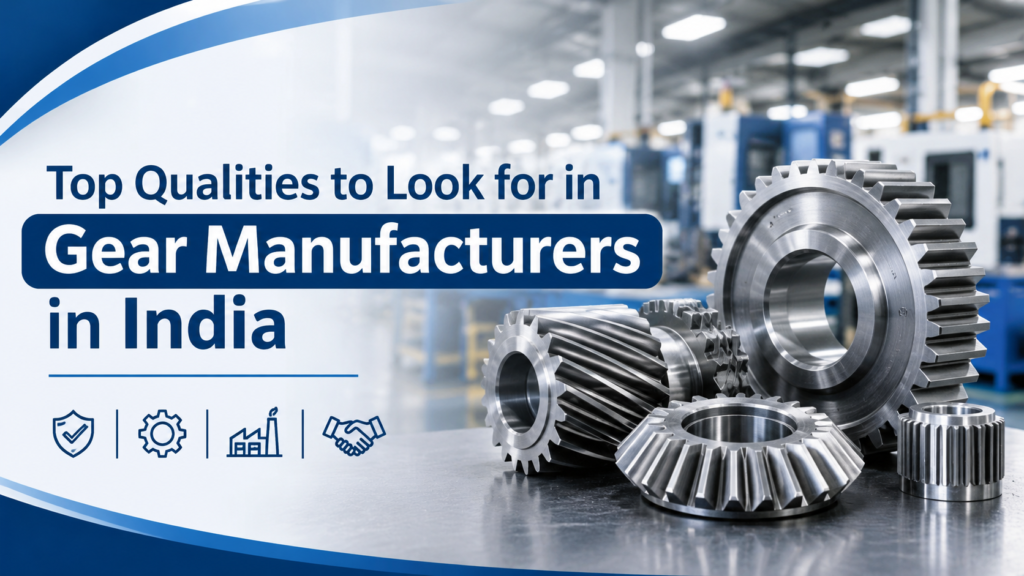
Choosing the right gear manufacturer is an important decision for businesses involved in industrial machinery, automotive components, heavy engineering, agriculture, power generation, and other manufacturing industries. Industrial gears play a crucial role in transferring power, controlling speed, and ensuring smooth machine operations. Therefore, selecting a reliable manufacturer can directly impact equipment performance, production efficiency, and long-term maintenance costs.
India has a growing industrial manufacturing sector with many companies offering different types of gears for domestic and international markets. However, not all manufacturers provide the same level of quality, precision, production capabilities, and technical support. Businesses should carefully evaluate several factors before selecting a manufacturing partner.
Whether you need standard industrial gears, customised components, or high-precision gear solutions, understanding the qualities of reliable gear manufacturers in India will help you make the right decision.
In this blog, we will discuss the top qualities to look for when choosing a professional gear manufacturing company.
1. Extensive Manufacturing Experience
Experience is one of the most important factors when selecting a gear manufacturing company. A manufacturer with years of industry experience generally understands different gear requirements, manufacturing challenges, material properties, and industrial applications.
Experienced manufacturers can handle complex specifications and recommend suitable gear solutions according to the machinery and operating conditions. They also have better knowledge of manufacturing processes, quality requirements, and industry standards.
When evaluating industrial gear manufacturers, check their company background, manufacturing history, completed projects, and industries they serve. A company with a proven track record can provide greater confidence in its production capabilities.
For example, Parkash Gears, based in Ludhiana, Punjab, has been serving the gear manufacturing industry since 1952, offering manufacturing experience and industrial expertise.
2. Advanced Manufacturing Technology and Machinery
Modern manufacturing technology plays a major role in producing accurate, durable, and high-performance gears. Reliable manufacturers invest in advanced machinery and equipment to maintain consistent production quality.
Gear manufacturing involves several specialised processes, including:
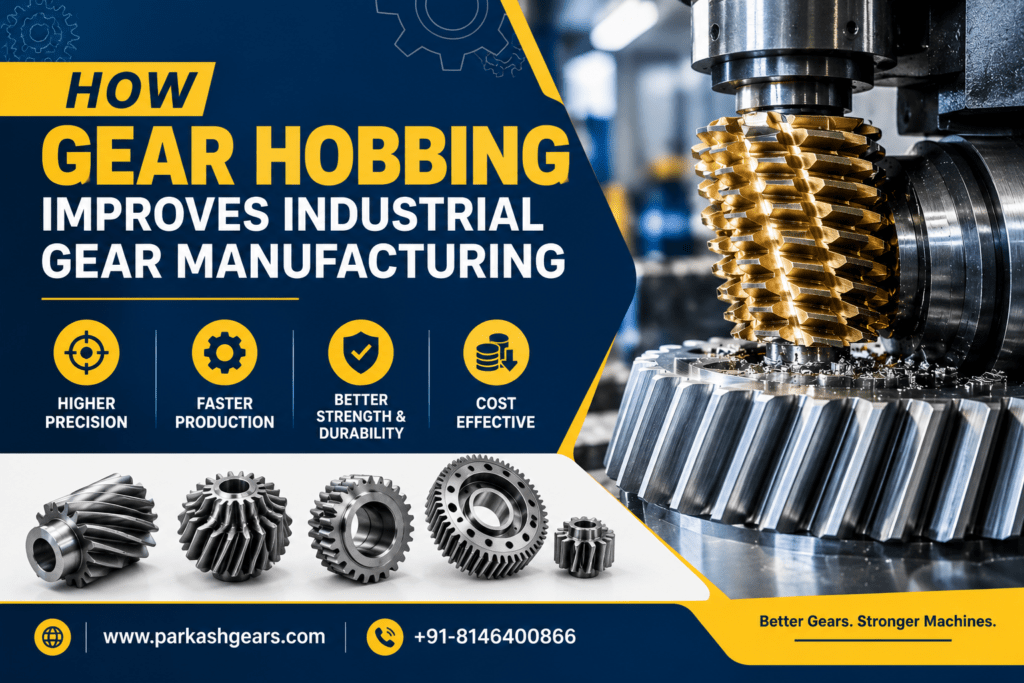
Gear hobbing
Gear shaping
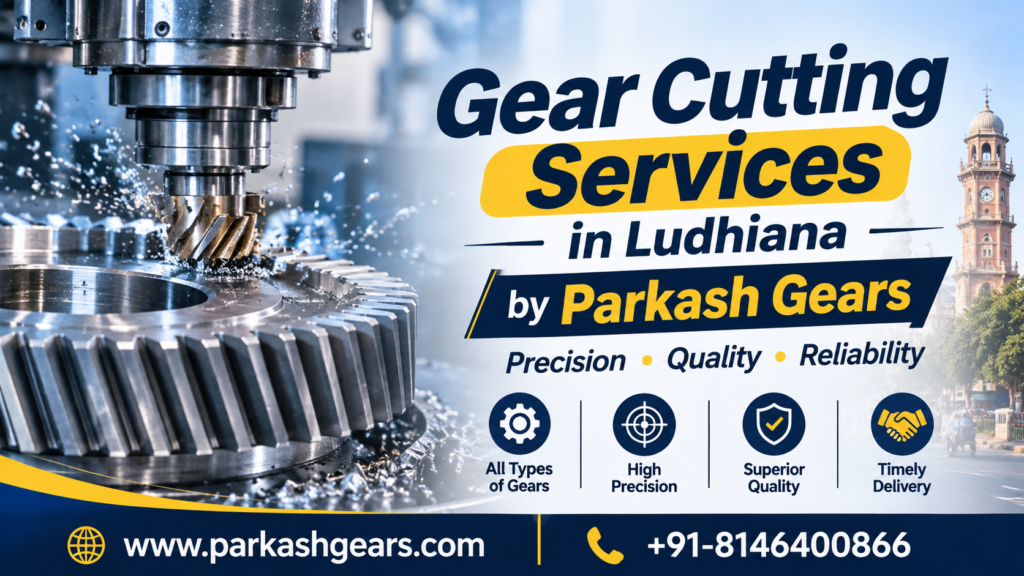
Gear cutting
Gear grinding
CNC machining
Gear finishing
Heat treatment
Advanced machinery helps manufacturers achieve accurate tooth profiles, proper dimensions, smooth surfaces, and consistent product quality.
When comparing gear manufacturers in India, ask about their available machinery, manufacturing facilities, and production technology. Companies using modern equipment are generally better equipped to manufacture customised gears and handle complex industrial requirements.
3. High Precision and Accuracy
Precision is essential in gear manufacturing because even small dimensional errors can affect the performance of industrial machinery. Incorrect tooth profiles, improper alignment, or inaccurate dimensions may result in vibration, noise, excessive friction, and premature component failure.
Professional precision gear manufacturers focus on maintaining strict dimensional accuracy throughout the manufacturing process.
Some important precision factors include:
Accurate gear tooth profiles
Correct pitch and tooth spacing
Proper alignment
Surface finish quality
Dimensional consistency
Low operating noise and vibration
Manufacturers should have proper inspection systems and measuring equipment to verify that every component meets the required specifications.
If your machinery operates under heavy loads or requires continuous production, choosing a precision-focused manufacturer becomes even more important.
4. Strict Quality Control and Inspection
Quality control is another important quality to consider when selecting an industrial gear supplier. A reliable manufacturer should follow proper inspection procedures at every stage of production.
Quality checks should not be limited to the final product. Instead, manufacturers should inspect raw materials, machining operations, heat treatment, finishing, and final dimensions.
A professional quality control process may include:
Raw material inspection
Hardness testing
Gear tooth measurement
Dimensional inspection
Surface quality testing
Metallurgical testing
Final product inspection
These procedures help identify manufacturing defects and ensure that gears meet the required performance standards.
Before placing a bulk order, ask the manufacturer about its quality assurance process and whether it can provide inspection reports or material testing documentation.
5. Ability to Manufacture Customised Gears
Different industries use different types of machinery, and each machine may require specific gear dimensions, designs, materials, and performance characteristics.
Therefore, choosing a manufacturer with custom gear manufacturing capabilities is highly beneficial.
Reliable manufacturers should be able to understand technical drawings, design specifications, samples, and application requirements to manufacture gears according to customer needs.
Custom manufacturing capabilities are particularly useful for businesses requiring:
Special gear dimensions
Non-standard tooth profiles
Heavy-duty industrial gears
Custom bevel gears
Helical gears
Special-purpose machinery gears
OEM gear components
Experienced industrial gear manufacturers can work closely with customers to develop products that match their machinery requirements.
This flexibility is especially important for OEM companies and businesses involved in specialised industrial equipment manufacturing.
6. High-Quality Raw Materials
The quality of raw materials directly affects the strength, durability, and working life of industrial gears.
Gears used in heavy machinery and industrial applications often operate under high loads, continuous movement, friction, and demanding working conditions. Using unsuitable materials can lead to premature wear, cracks, deformation, and component failure.
Professional gear manufacturers carefully select materials according to the application and operating requirements.
Common materials used in gear manufacturing include:
Alloy steel
Carbon steel
Stainless steel
Case-hardening steel
Special engineering steels
The material selection depends on factors such as load capacity, operating speed, temperature, hardness, and environmental conditions.
When selecting a manufacturer, always ask about its material sourcing, material specifications, and testing procedures.
7. Heat Treatment and Metallurgical Expertise
Heat treatment is an important manufacturing process that improves the mechanical properties of gears. It helps achieve the required hardness, wear resistance, strength, and durability.
Different industrial applications require different heat treatment processes depending on the gear material and operating conditions.
Some commonly used heat treatment processes include:
Carburising
Induction hardening
Nitriding
Through hardening
Tempering
A manufacturer with proper heat treatment capabilities can produce gears that perform reliably under demanding operating conditions.
Metallurgical testing is also valuable because it helps verify material properties and heat treatment results.
When evaluating precision gear manufacturers, check whether they have access to heat treatment facilities, hardness testing equipment, and metallurgical inspection services.
8. Wide Range of Gear Manufacturing Capabilities
A good gear manufacturing company should offer a wide range of products to meet different industrial requirements.
Working with a manufacturer that produces multiple gear types can simplify procurement and help maintain consistent quality across different components.
Depending on your industrial needs, look for manufacturers offering:
Bevel gears
Helical gears
Spur gears
Worm gears
Spiral bevel gears
Helical bevel gears
Industrial transmission gears
Custom-engineered gears
Different gears serve different purposes. For example, bevel gears are commonly used to transmit power between intersecting shafts, while helical gears are suitable for smooth and efficient power transmission.
A manufacturer with diverse production capabilities can support businesses across multiple industrial sectors.
9. Strong Production Capacity and Timely Delivery
Production capacity is an important consideration, especially for businesses that require bulk orders or regular gear supplies.
A manufacturer may offer excellent product quality, but insufficient production capacity can create delays in your manufacturing schedule.
Before finalising a supplier, evaluate its ability to handle your order quantity and delivery requirements.
Consider the following factors:
Monthly production capacity
Availability of manufacturing machinery
Workforce and technical expertise
Raw material availability
Bulk order handling
Production planning
Delivery timelines
Reliable manufacturers should provide realistic delivery schedules and maintain clear communication throughout the production process.
This is particularly important for OEM companies, machinery manufacturers, and industrial businesses that depend on a continuous supply of components.
10. Experience Across Multiple Industries
Different industries have different gear performance requirements. A manufacturer with experience across multiple sectors can better understand specific application challenges.
For example, gears used in agricultural machinery may require different performance characteristics compared to gears used in cement plants or steel manufacturing units.
Look for manufacturers serving industries such as:
Agriculture and farming equipment
Sugar and oil mills
Cement plants
Steel and rolling mills
Power generation
Heavy engineering
Mining and minerals
Material handling and conveyors
Textile machinery
Food processing equipment
Marine and industrial machinery
Manufacturers with diverse industry experience are often better prepared to handle different technical requirements and specialised gear applications.
11. Competitive Pricing and Overall Value
Pricing is an important factor when selecting a gear manufacturer, but choosing a supplier based only on the lowest quotation can create problems in the long run.
Low-cost gears may not always offer the required material quality, dimensional accuracy, or durability.
Instead of comparing prices alone, evaluate the overall value offered by the manufacturer.
Consider:
Product quality
Raw material standards
Manufacturing accuracy
Production consistency
Delivery commitments
After-sales support
Expected product life
A reliable manufacturer should offer competitive pricing without compromising on quality.
For bulk buyers, wholesalers, exporters, and OEM companies, it is also useful to discuss long-term pricing arrangements and repeat-order requirements.
12. Reliable Customer Support and Technical Assistance
Good customer support makes the manufacturing process easier and more efficient. A professional gear manufacturer should understand customer requirements and provide technical guidance whenever needed.
From the initial enquiry to product delivery, clear communication helps avoid misunderstandings and manufacturing errors.
Look for manufacturers who can assist with:
Technical specifications
Gear selection guidance
Drawing and design discussions
Material recommendations
Custom manufacturing requirements
Order tracking
Product-related queries
Technical assistance is particularly valuable when developing customised gears or replacing components in existing industrial machinery.
A manufacturer that values long-term customer relationships can become a dependable business partner.
Why Choosing the Right Gear Manufacturer Matters
Selecting the right manufacturing partner is not just about purchasing industrial components. It is about ensuring the long-term reliability and efficiency of your machinery.
The right manufacturer can help your business achieve several benefits:
Improved Machine Performance: Accurately manufactured gears help ensure smooth power transmission and reliable machinery operation.
Reduced Maintenance Costs: Durable gears can minimise premature wear, unexpected breakdowns, and frequent replacements.
Better Production Efficiency: Consistent manufacturing quality supports uninterrupted industrial operations.
Long-Term Reliability: High-quality materials and proper manufacturing processes improve gear performance and service life.
Customised Industrial Solutions: Experienced manufacturers can develop gears according to specific machine requirements.
Consistent Bulk Supply: Established production facilities can support regular orders and large-scale manufacturing requirements.
For industrial businesses, selecting a reliable manufacturing partner can make a significant difference in operational efficiency and overall production costs.
Parkash Gears – An Experienced Gear Manufacturer in India
When searching for reliable gear manufacturers in India, experience, manufacturing capabilities, product quality, and technical expertise should always be important considerations.
Parkash Gears is an established gear manufacturing company based in Ludhiana, Punjab, India, with a manufacturing history dating back to 1952.
The company focuses on manufacturing industrial gears and providing gear solutions for different machinery and engineering applications.
With extensive industry experience, Parkash Gears serves businesses looking for quality gear manufacturing and customised industrial gear requirements.
Key capabilities include:
Industrial gear manufacturing
Bevel gear manufacturing
Helical gear manufacturing
Custom gear manufacturing
Gear teeth cutting
Heavy-duty industrial gears
Heat treatment services
Metallurgical testing and inspection
The company serves various industrial sectors, including agriculture, sugar mills, cement, steel, heavy engineering, power plants, conveyors, and other machinery applications.
Whether you require standard industrial gears or customised gear components, choosing an experienced manufacturer with the right technical capabilities is essential.
Explore Parkash Gears to learn more about its industrial gear manufacturing capabilities.
Website: https://parkashgears.com/
Conclusion
Finding the right gear manufacturer requires careful evaluation of several factors, including manufacturing experience, advanced machinery, precision, quality control, raw materials, customisation capabilities, and production capacity.
India has many manufacturing companies, but businesses should focus on selecting a partner that understands their technical requirements and maintains consistent product quality.
Whether you are searching for industrial gear manufacturers, comparing precision gear manufacturers, or looking for dependable gear manufacturers in India for bulk and OEM requirements, always prioritise quality, reliability, and long-term value over price alone.
A trusted manufacturing partner can help improve machinery performance, reduce maintenance costs, and support your business’s long-term industrial growth.
Frequently Asked Questions (FAQs)
1. How do I choose the best gear manufacturers in India?
Look for manufacturing experience, advanced machinery, precision capabilities, quality control procedures, raw material standards, product range, and timely delivery.
2. What types of gears are manufactured in India?
Indian manufacturers produce bevel gears, helical gears, spur gears, worm gears, spiral bevel gears, helical bevel gears, and customised industrial gears.
3. What are industrial gear manufacturers?
Industrial gear manufacturers are companies that design and produce gears used in machinery and equipment for industries such as agriculture, cement, steel, mining, power generation, and heavy engineering.
4. Why is precision important in gear manufacturing?
Precision ensures correct tooth profiles, proper alignment, smooth power transmission, reduced vibration, and reliable machinery performance.
5. What materials are commonly used in gear manufacturing?
Common materials include alloy steel, carbon steel, stainless steel, and specialised engineering steels. Material selection depends on the gear application and operating conditions.
6. Do Indian gear manufacturers offer customised gear solutions?
Yes. Many experienced manufacturers produce customised gears according to technical drawings, dimensions, material specifications, and machinery requirements.
7. What is the role of heat treatment in gear manufacturing?
Heat treatment improves gear hardness, strength, wear resistance, and durability, helping gears perform under demanding industrial conditions.
8. Which industries require industrial gears?
Agriculture, automotive, cement, sugar, steel, mining, power generation, textile, food processing, and heavy engineering industries commonly use industrial gears.
9. What should OEM companies check before selecting a gear manufacturer?
OEM companies should evaluate production capacity, dimensional accuracy, customisation capabilities, material quality, inspection procedures, bulk supply capability, and delivery commitments.
10. Where can I find experienced gear manufacturers in Ludhiana, India?
Ludhiana has an established industrial manufacturing sector. Parkash Gears is one of the experienced gear manufacturing companies based in Ludhiana, Punjab, with a history dating back to 1952.