
Heat Treatment of Gears: Types, Processes, Benefits & Industrial Applications
Gears play an important role in industrial machinery by transmitting power and controlling motion between rotating components. They are commonly used in automotive systems, agricultural equipment, industrial gearboxes, and heavy-duty machinery. However, gears operating under high loads and continuous working conditions require excellent strength, hardness, and wear resistance. This is where heat treatment of gears becomes essential.
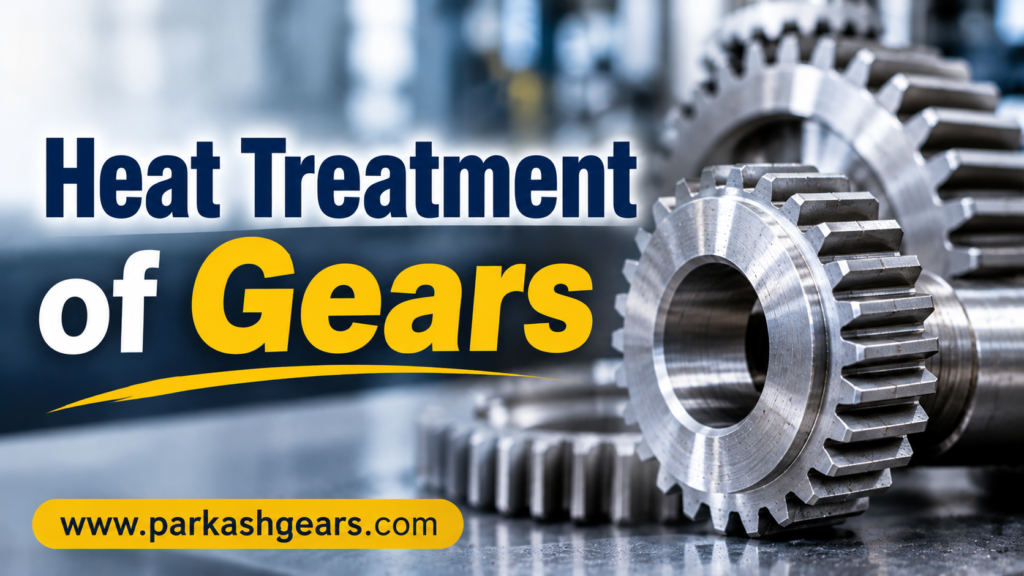
Gear heat treatment is a manufacturing process that involves controlled heating and cooling of metal components to improve their mechanical properties. It helps increase surface hardness, improve strength, reduce wear, and extend the service life of industrial gears. In this guide, we will explore different gear heat treatment methods, their processes, benefits, and industrial applications.
What Is Heat Treatment of Gears?
Heat treatment of gears is a controlled thermal process used to modify the physical and mechanical properties of gear materials. Depending on the application, different heating and cooling techniques are used to achieve the required hardness and toughness.
The main purpose of gear heat treatment is to make gear teeth strong enough to handle friction, repeated contact, heavy loads, and continuous operation. Selecting the appropriate treatment depends on the gear material, design, operating conditions, and performance requirements.
Types of Gear Heat Treatment Processes
Different heat treatment methods are used in industrial gear manufacturing. Three commonly used processes include case hardening, induction hardening, and through hardening.
1. Case Hardening
Case hardening is a process that creates a hard outer surface while maintaining a relatively tough and ductile inner core. It is commonly used for gears that experience high contact stress and repeated friction.
Carburizing is a widely used case-hardening technique in which carbon is introduced into the surface of low-carbon steel. The component is then hardened through controlled heat treatment and quenching.
This method improves wear resistance and helps protect gear teeth against surface damage, making it suitable for automotive gears and heavy-duty industrial applications.
2. Induction Hardening
Induction hardening uses electromagnetic induction to heat specific areas of a gear, usually the teeth and surrounding surfaces. The heated section is rapidly cooled using a suitable quenching method to achieve higher surface hardness.
One major advantage of induction hardening is that it allows manufacturers to harden selected areas without treating the entire component. It is commonly used for large gears, transmission components, and industrial machinery parts.
3. Through Hardening
Through hardening involves heating the entire gear to a specific temperature and cooling it under controlled conditions. Unlike case hardening, this process increases hardness throughout the gear rather than only at the surface.
It is suitable for applications requiring uniform strength and hardness across the component. Medium-carbon and alloy steels are commonly used for this process.
Benefits of Heat Treatment in Gear Manufacturing
Proper heat treatment offers several advantages for industrial gear performance:
- Improved Hardness: Increases resistance to surface wear and friction.
- Greater Strength: Helps gears withstand demanding operating conditions.
- Longer Service Life: Reduces premature damage and component replacement.
- Better Durability: Improves resistance to repeated loading and mechanical stress.
- Reliable Performance: Supports consistent power transmission in industrial machinery.
Industrial Applications of Heat-Treated Gears
Heat-treated gears are widely used across different industries because of their improved mechanical properties. Common applications include automotive transmissions, agricultural machinery, industrial gearboxes, construction equipment, material-handling systems, manufacturing machinery, and heavy-duty power transmission equipment.
The appropriate heat treatment method depends on the load, operating speed, material selection, and working environment.
Conclusion
Heat treatment of gears is an important stage in industrial gear manufacturing. Processes such as case hardening, induction hardening, and through hardening help improve gear strength, surface hardness, wear resistance, and overall durability.
Choosing the right treatment method ensures reliable gear performance and longer service life. Parkash Gears focuses on industrial gear manufacturing in Ludhiana, Punjab, with attention to precision, material selection, and application-specific manufacturing requirements.
Frequently Asked Questions (FAQs)
1. What is heat treatment of gears?
Heat treatment is a process that improves gear hardness, strength, durability, and wear resistance through controlled heating and cooling.
2. What are the main types of gear heat treatment?
The main types include case hardening, induction hardening, and through hardening.
3. What is case hardening in gear manufacturing?
Case hardening creates a hard outer surface while maintaining a tough inner core.
4. How does induction hardening improve gear durability?
It increases surface hardness and improves resistance to friction, wear, and mechanical stress.
5. Which materials are used for heat-treated gears?
Common materials include carbon steel, alloy steel, and low-carbon steel.
6. Why is heat treatment important for industrial gears?
It improves strength, reduces wear, increases service life, and supports reliable machinery performance.
7. Which heat treatment is best for heavy-duty industrial gears?
The choice depends on gear material, load, application, and required hardness. Case hardening and induction hardening are common options.