

In short
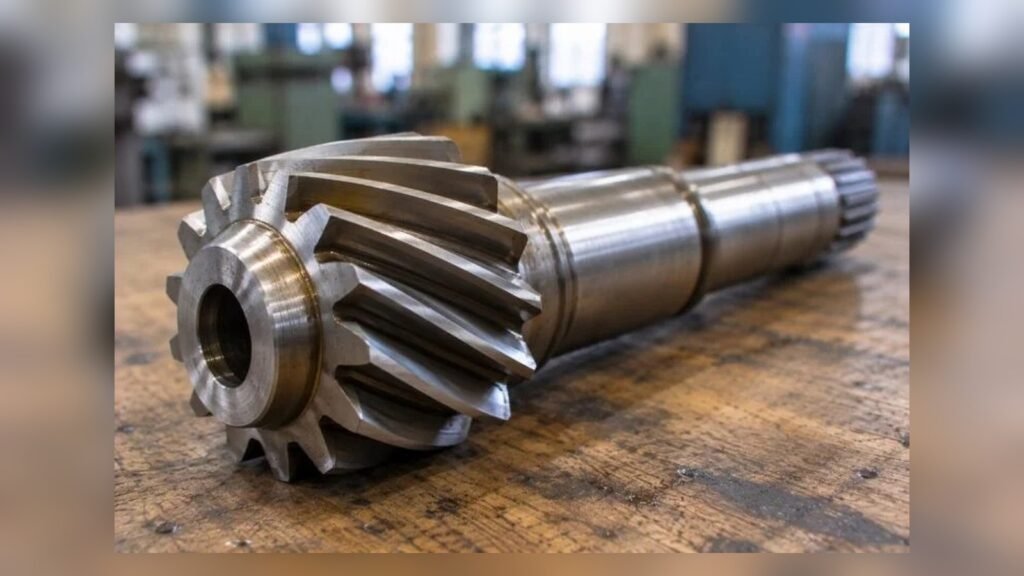
A shaft pinion is a pinion cut straight onto its own shaft. So there is no separate gear and no key. It is strong and small, but every size on it has to be right.
Purana ghis gaya hai? Sample bhejiye, hum waisa hi bana denge.
What a shaft pinion is
On many drives the pinion is a loose gear, and a key holds it on the shaft. On this type, however, the teeth sit in the shaft itself. So the pinion and the shaft are one solid piece.
That removes the weakest joint, the key. As a result, the one-piece design takes shock and high load better. There is nothing to shear and nothing to work loose.
You find this part wherever a drive needs a strong pinion in a small space. For example, gearbox input and output stages, pump drives, compressor drives, machine tool spindles and farm machines all use one. That is why designers pick it for the high load stage of a drive.
Picking the steel
The steel decides how long the part lasts. So we match it to the duty.
For light work, EN8 or EN9 is enough. For a tough, through hardened part, we usually pick EN19. But for a hard face with a tough core, we pick EN353 or 20MnCr5. We also tell you the grade with the order, so you have a record.
How a pinion shaft is made
The part goes through clear stages:
- Turning. First we turn the bar to size and put a centre at each end.
- Cutting the teeth. Next we hob or shape the teeth to the right module and tooth count.
- Hardening. After that, the teeth are hardened for wear life.
- Grinding. Then we grind the journals, and the teeth too if the job needs it.
- Checking. Finally we measure run-out, tooth size and hardness.
Har stage check hoti hai, taaki final piece sahi bane.
Sizes that matter
A pinion shaft usually fails at the fits, not at the teeth. So a few sizes must be tight.
The bearing journals must be round and on size, or the bearing runs hot. The teeth need the right thickness, because that sets the backlash. And the whole shaft must run true, or it whips at speed.
People ask for a number. It depends on the machine, but a few rules hold.
Bearing seats are the tightest part. We hold them in microns, not in half millimetres. We also set the tooth thickness so the pair has a little play, not none. Too much play makes noise. Too little makes the teeth bind and heat up.
Run-out over the full length is the third one to watch. A shaft that is true at the ends can still bow in the middle. So we check it between centres before the part leaves.
Why grinding comes last
Heat moves metal. Because of that, a part that was perfect before hardening can distort a little in the furnace.
If you stop there, the bearing seats sit off centre and the shaft runs out. So afterwards we grind the journals, and the teeth too where the grade needs it. We grind to the sizes on your drawing. In short, this step separates a long life part from a noisy one.
Purana part se copy kaise banta hai
You do not need a drawing. The old piece is the drawing. So send us:
- The old part, broken pieces included
- The two end diameters and the overall length
- The bore sizes, if gears or bearings sit on it
- A photo of the part in the machine
From these we work out the module, the tooth count, the pressure angle and the fits. But if a journal has worn away, tell us, and we cut the new one from the good sections.
A rough tooth face is noisy and wears fast. A ground face runs quieter and holds oil better. So on fast drives the finish is worth paying for. On slow, heavy drives, however, a good cut face is often enough.
Dispatch ke pehle har piece check hota hai. We measure the journals, the tooth size and the run-out, and we also look at the tooth face with the eye. A part that passes all four goes out. One that does not goes back on the machine.
Teeth cutting and job work
Some workshops bring a turned blank and want only the teeth cut. So we take that as gear cutting job work: hobbing, shaping, bevel generation, keyway and spline cutting, and grinding.
To see the range, look at all our gears or the pinion shaft page.
Cost and lead time
Price depends on length, diameter, steel and finish. So send a photo on WhatsApp with the sizes. Same day quote milta hai. Delivery is 1 to 2 days for most parts. But for very large pieces we check stock and discuss.
We supply across Punjab, Chandigarh, Haryana, Himachal and Delhi NCR, and we also send gears all over India by transport.
FAQ
Ek hi piece bhi banate ho?
Haan. Single piece bhi, batch order bhi. One pinion shaft is a normal order for us.
Kitne din mein mil jayega?
Most parts in 1 to 2 days. Bade piece ke liye hum baat karke batate hain.
Can you copy a worn pinion shaft?
Yes. The old part gives us every size we need.
Which steel should I pick?
EN19 for a tough part, EN353 for a hard face. We then suggest the right one for the load.
Do you grind the bearing seats?
Yes. We grind the journals so the part runs true and the bearings sit tight.
Talk to us
Parkash Gears, 528, Oswal Street, Miller Ganj, Ludhiana, Punjab 141003.
Call or WhatsApp Ashok Goyal: +91 9915280866, +91 8146400866
Manufacturing gears since 1952. MSME (Udyam) registered.